Selling a Florida Mortgage Note
How One Note Seller Found Confidence in a Process He Had Never Been Through Before
When someone sells a mortgage note for the first time, the numbers matter.
But so does knowing what is happening.
“Frank” had never sold a mortgage note before. He had loaned approximately $300,000 to a family friend so she could purchase a home in Florida. The loan was performing well, and the borrower had actually been paying considerably more than her required monthly payment.
Now Frank was considering selling the note.
He wanted to know what it was worth, what his choices were, and what would happen if he decided to move forward.
By the time the transaction was over, Frank sent me a note I won’t soon forget:
“My company and I cherish integrity as a core value and thank you for yours. The whole experience was exceptional.”
Here’s what happened.
Meet Frank
Frank had helped a family friend purchase a single-family home in Florida.

Unlike many of the note holders who contact me, Frank hadn’t sold the property and taken back a mortgage. He had provided the financing that allowed his friend to purchase the home.
An attorney prepared the promissory note and mortgage, and Frank funded approximately $300,000 at closing. The borrower had also put substantial cash into the purchase.
The note carried an interest rate a little over 7%, with scheduled monthly payments of approximately $2,000 and a balloon payment after three years.
But something interesting had been happening.
Instead of making the required payment, the borrower had generally been paying about $3,000 each month. The additional money was being applied to principal, so the balance was declining faster than originally scheduled.
When Frank contacted me, he wanted to explore selling his Florida Mortgage note.
We had a brief initial conversation.
Afterward, I emailed him.
“Frank, in order to evaluate the real estate note, I need more specifics.”
I asked about the property, the original transaction, the loan terms and the borrower, and requested copies of the note and closing documents.
There was another point I wanted him to understand.
The borrower wouldn’t be contacted while we were simply evaluating his note.
First, I needed to understand what Frank owned and what he wanted to accomplish.
Transaction Summary
The Florida note holder had provided private financing to help a family friend purchase a home. When he later decided to sell the real estate note, American Funding Group evaluated the transaction, completed due diligence and purchased the note. The transaction closed successfully, and the seller later described the process as straightforward, transparent and free of surprises.
Actual Transaction
This story is based on an actual mortgage note transaction completed by American Funding Group.
The note holder’s and borrower’s names and certain identifying details have been changed or omitted to protect their privacy. Some figures have been rounded, and conversations have been reconstructed from contemporaneous notes and correspondence. The transaction and events described are real.
The underlying note appeared strong.
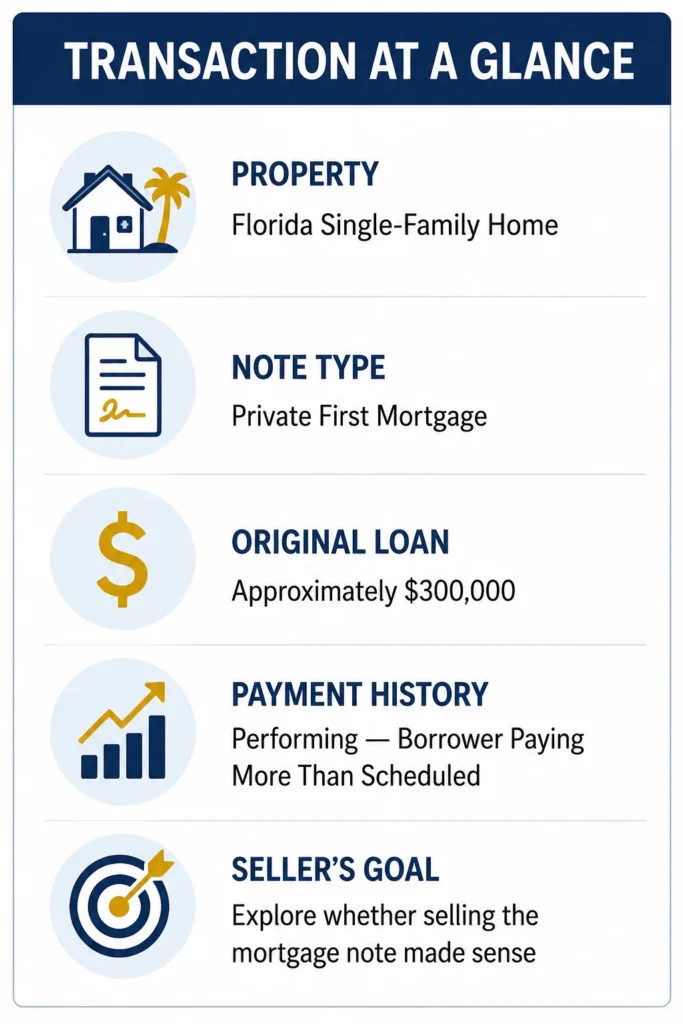
The home had sold for a little over $400,000. Frank had financed approximately $300,000 of the purchase, and the borrower had put substantial cash into the property.
More importantly, the borrower was paying.
And she wasn’t merely making the scheduled payments. She was paying additional principal.
Once I had enough information to evaluate the note, I showed Frank two possibilities.
He could sell the entire note.
Or he could sell only part of it. See how a partial mortgage note sale works.
I laid out both alternatives and ended with a question:
“Which offer comes closest to meeting your needs?”
Frank considered the alternatives and decided he wanted to explore a full sale.
That’s when we discovered something important.
Behind the Scenes
The note balance we initially calculated didn’t match Frank’s balance.
Frank explained why.
The borrower had made additional principal payments.
Rather than estimate our way through the difference, I asked Frank to send me the dates and amounts of the payments.
He did.
Then he sent another message clarifying one of the entries so there wouldn’t be any misunderstanding.
I sent the payment history to our analysts and asked them to take a fresh look.
The additional principal payments meant the unpaid balance was lower than we had originally calculated.
That meant our purchase numbers had to change, too.
I explained that to Frank and gave him the revised figures.
There wasn’t any reason to dance around it. The numbers were the numbers.
Frank’s response told me something about what mattered to him:
“Thanks again for all of your help and transparency in this process.”
That was important.
Because we weren’t finished.
Now we had to verify everything.
Developing the Best Fit
Once Frank decided to proceed with the full sale, I sent him our Mortgage Purchase Agreement.
“Okay… let me explain.”
Signing the agreement allowed us to begin spending our money on due diligence. We would verify the payment history, evaluate the property, review the documents and examine the title.
Frank returned the agreement and began sending what he had.
The mortgage.
The promissory note.
Payment records.
But some information wasn’t readily available.
Frank wasn’t the seller of the property, so he didn’t have the original closing statement.
That document mattered.
I asked him to go back to the attorney who had handled the transaction and request a copy.
Frank did.
A few days later, he wrote:
“I finally got word from the closing attorney that he is working on my request for a copy of the closing statement.”
When the attorney provided it, Frank sent it over.
That’s often how these transactions unfold.
You don’t necessarily receive a perfect package on the first day. We start with what the note holder has, identify what’s missing, and work through the questions as they arise.
Frank and I stayed in touch throughout the process.
When the property evaluation came in fine, I told him.
When we reached the point where borrower contact became relevant, I asked Frank for permission first.
As underwriting progressed, we kept him informed.
Frank didn’t need to understand everything happening behind the scenes.
But he shouldn’t have to wonder where things stood.
Achieving the Objective
The note was approved.
The property evaluation supported the transaction.
The documentation was completed.
The title work came in.
And the transaction moved toward closing.
On the morning of the scheduled closing, I emailed Frank:
“I understand that the closing is going to take place today at 5pm. Congratulations!”
The transaction closed and funded.
The next day, Frank confirmed that the wire had cleared.
But what he said afterward mattered to me more than simply knowing the transaction had closed.
Frank had written a five-star Google review.
Then he emailed me privately:
“I meant every word.”
He went on to explain that integrity was a core value in his own business.
Then he thanked me for mine.
“The whole experience was exceptional.”
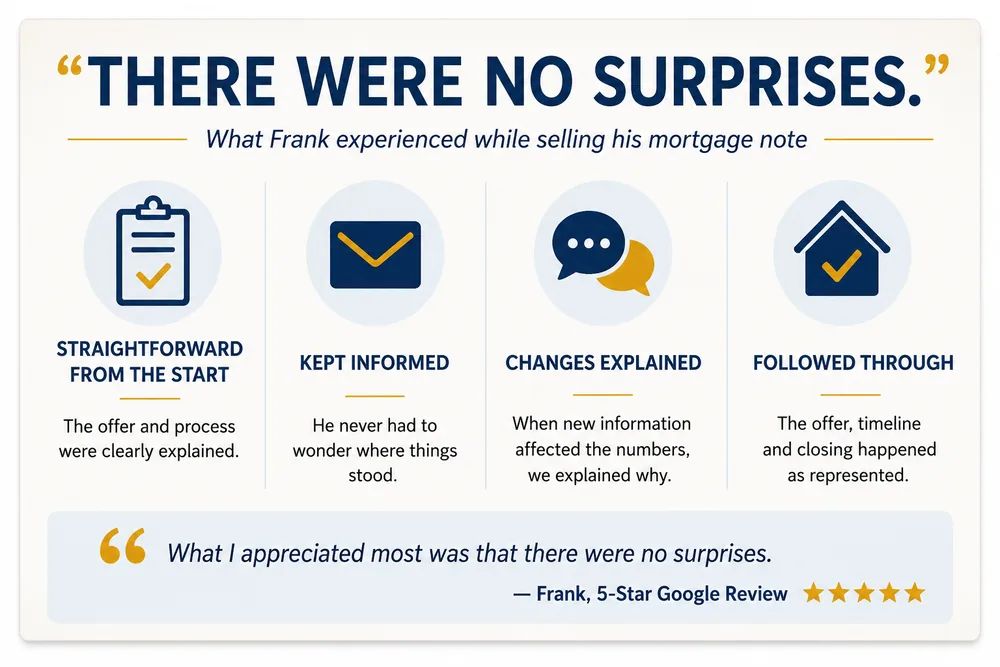
That brought the transaction full circle.
Frank had started with a mortgage note he had never sold before and questions about what it was worth and how the process worked.
Along the way, the numbers changed.
Documents had to be located.
Payment records had to be reconciled.
Due diligence had to be completed.
None of those things prevented the transaction from moving forward.
Frank simply needed to know what was happening and why.
Google Review
★★★★★
“I don’t write reviews normally, but Kevin Clancy and the team at American Funding Group definitely earned this one.
I recently sold a real estate note through them, and the process was much easier than I expected. From the first phone call, Kevin was straightforward, patient, and took the time to explain everything without any pressure. He answered every question I had and always kept me updated, so I never had to wonder where things stood.
What I appreciated most was that there were no surprises. The offer, the timeline, and the closing all happened just as he said it would. It’s refreshing to work with someone who is honest, follows through on his commitments, and genuinely cares about treating his clients fairly.
If you’re thinking about selling a real estate note, I wouldn’t hesitate to recommend Kevin Clancy and American Funding Group. They made the entire experience smooth, professional, and stress-free, and I would gladly work with him again.”
About the Author
Kevin Clancy is President of American Funding Group and has been purchasing private mortgage notes since 1989. Over more than three decades, he has helped note holders nationwide evaluate and sell performing, non-performing, inherited, divorce-related, and other real estate notes, including full and partial note purchases.
Kevin’s Take
Frank’s review meant a lot to me.
Not because he gave us five stars.
It was what he said about the experience.
“There were no surprises.”
That’s important to me.
A mortgage note transaction has moving parts.
We may discover something during due diligence that wasn’t known when we first talked. A balance may need to be corrected. A document may be missing. Title may raise a question.
My job isn’t to pretend those things don’t happen.
It’s to explain what’s happening when they do.
In Frank’s case, we discovered that the borrower had paid down more principal than we originally knew.
That changed the balance and changed our numbers.
So we recalculated them and explained why.
Later, we needed documentation Frank didn’t have.
We worked with him to get it.
At each point, Frank knew where things stood.
I think that’s what he was describing when he talked about integrity.
Trust isn’t something I can ask a note holder to give me.
It develops when I do what I said I would do, explain things when they need explaining, and tell someone when something changes.
Frank gave us the opportunity to earn his trust.
I’m glad we did.
Thinking About Selling Your Mortgage Note?
If you’ve never sold a mortgage note before, you probably have questions.
What is my note worth?
Should I sell all of it or only part of it?
What information will you need?
Will you contact my borrower?
What happens during due diligence?
And perhaps the biggest question:
How do I know I’m dealing with someone I can trust?
Those are reasonable questions.
You don’t need to know everything about selling a mortgage note before you call me.
That’s what the conversation is for.
I’ll ask some questions about your note and what you’re trying to accomplish. Then I’ll explain what I see and what your options may be.
After that, the decision is yours.
If you’d like to talk about your mortgage note, call me at (772) 232-2383 or request a confidential note evaluation.
No pressure. Just a conversation about your note and what may be possible. Or you may fill out the form below to get started.
📞 Call (772) 232-2383 or Get My Note Quote Now
Related Stories
More Real-Life Stories are being developed. Check out these real-life stories:
> Selling a Texas Mortgage Note