Selling a Texas Mortgage Note
How One Family Found a Better Solution
When people think about selling a mortgage note, they often assume there are only two choices: keep collecting the monthly payments or sell the entire note. After purchasing mortgage notes for more than three decades, I’ve learned that the best solution is often somewhere in between.
Meet Ron and Linda
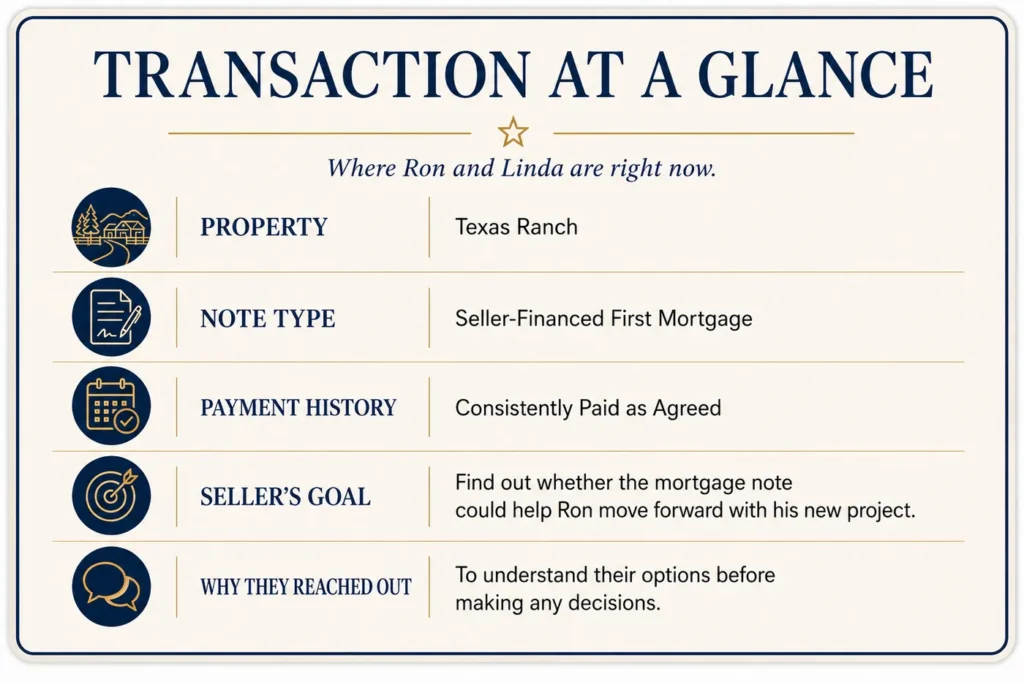
Ron had spent years building his Texas ranch. When he eventually sold it, he financed part of the sale and accepted a mortgage note that provided dependable monthly income.

Certain names and identifying details have been changed or omitted to protect our client’s privacy, but the events and transaction described are real.
Years later, the note was still performing well. It was held in Ron’s revocable trust, the borrower was making payments, and the ranch provided substantial security.
But Ron was getting older, and he had another project in mind. Could his Texas mortgage note provide the capital he needed to move forward?
His daughter, Linda, took on the responsibility of finding out whether the mortgage note could help.
That’s when she called me.
“Have you ever sold a mortgage note before?” I asked.
“No,” she said. “I’m trying to find out what Dad’s options are.”
“Okay… let me explain.”
Linda wasn’t calling because the borrower had stopped paying or because the family was under pressure. She simply wanted to know whether selling the note could provide the money her father needed.
At first, she assumed that meant selling all of it.
As we talked, she began to realize there might be another way.
Actual Transaction
This story is based on an actual mortgage note transaction completed by American Funding Group.
Ron had sold a large Texas ranch through owner financing. Instead of receiving the entire purchase price at closing, he accepted a substantial down payment and carried a mortgage note for the balance.
The note had performed exactly as intended. The borrower had established a strong payment history, the property had substantial equity, and the monthly payments continued to provide dependable income.
Ron didn’t want to give up a good asset unnecessarily.
He simply needed enough cash to move forward with another project.
Linda’s first question was the one most note holders ask:
“How much would someone pay for the note?”
Before I could answer, I needed to understand what Ron was trying to accomplish.
“How much money does your father actually need?” I asked.
Linda gave me a general idea.
“And does he want to give up all of the future payments?”
She paused.
“No. Not if he doesn’t have to.”
That answer changed the conversation.
Transaction Overview
A Texas note holder had sold a large ranch using owner financing and retained a well-performing mortgage note secured by the property. Years later, he wanted access to enough capital for another project without unnecessarily giving up all of his future note income.
After evaluating the note, property, payment history, equity, title, and the family’s objectives, American Funding Group helped the family compare a complete note sale with a partial sale. They ultimately chose a partial sale, providing the cash needed for the new project while preserving a significant future interest in the note.
Behind the Scenes
While Linda and I were discussing Ron’s goals, I was also gathering the information needed to understand the note.
I asked about the property, the original sale, the borrower, the payment history, and how the note was held.
Then we reviewed the note and mortgage documents, verified the payment record, examined the property’s current value and available equity, and checked the title.
I wasn’t asking those questions to put Linda through a process. I needed to understand what they owned before I could explain what they could safely do with it.
A mortgage note is more than an unpaid balance and a monthly payment.
The strength of the payment history matters. The borrower’s ability and willingness to continue paying matter. The property, the equity, the lien position, the documents, and the title all matter.
In Ron and Linda’s case, the pieces fit together well.
The borrower had paid consistently. The ranch provided substantial security. The documents supported the transaction.
That gave the note value.
More importantly, it gave Ron and Linda options.
Developing the Best Fit
Once I understood the note, I could begin explaining the alternatives.
Linda still wanted to know what a complete sale would look like, so we discussed it first.
Selling the entire note would provide the largest immediate lump sum. In exchange, Ron would transfer all of the remaining payments and give up his future interest in the note.
Then I asked Linda another question.
“What if your father could receive the money he needs now and still keep some of the future payments?”
There was a pause.
“You can do that?”
“Yes,” I said. “It’s called a partial sale.”
“Okay… let me explain.”
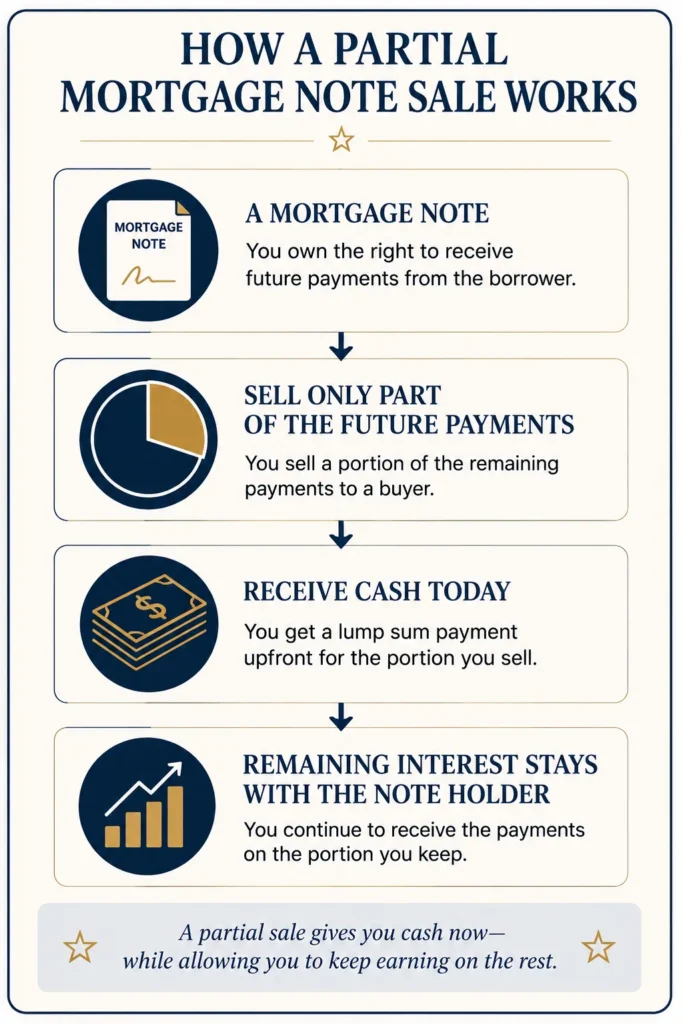
Instead of selling the entire note, Ron could sell a specific portion of the future payments. That could provide the capital he needed while allowing him to retain a meaningful interest in the note.
Linda began working through the idea herself.
“So Dad could get the money for his project, but he wouldn’t have to sell everything?”
“That’s right.”
“And after the part that was sold had been paid, the payments could come back to him?”
“Depending on how we structure it, yes.”
That was the moment the partial-sale alternative began to make sense to her.
The decision was no longer between keeping the note and selling all of it.
Now the question was how much cash Ron needed, how much future income he wanted to preserve, and which combination worked best for him.
There wasn’t one universally correct answer.
A complete sale would provide more cash immediately.
A partial sale would provide less cash immediately but allow Ron to retain future value.
Only Ron and Linda could decide which balance felt right.
My job was to make sure they understood the choices.
Learn more about how a partial mortgage note sale works.
Achieving the Objective
After reviewing the alternatives, Ron and Linda chose a partial sale.
It provided the capital Ron needed for his project without requiring him to give up the entire mortgage note.
Once they made that decision, we coordinated the remaining work, including final due diligence, title review, document preparation, funding, and closing.
The transaction closed smoothly.

Ron received the money he needed, and the family retained a significant future interest in the note.
They were comfortable with the outcome because they understood how it had been developed. It wasn’t a solution handed to them. It was one they had helped uncover.
Choosing between immediate cash and future income is personal.
The right answer depends on what the money is for, what the note holder wants to preserve, and what will leave the family in the strongest position afterward.
Ron and Linda found the balance that worked for them.
Google Review
⭐⭐⭐⭐⭐
“I had an excellent experience working with Kevin Clancy at American Funding Group to sell a note I was carrying on a property. From the very beginning, they were honest, upfront, and professional. The entire process was clearly explained, and there were never any surprises along the way.
“Communication was outstanding from start to finish. Every question I had was answered promptly, and they kept me informed throughout each step of the transaction. Their team was knowledgeable, efficient, and easy to work with, making what could have been a complicated process feel simple and stress-free.
“Most importantly, they did exactly what they said they would do. The transaction closed smoothly, and everything was handled with integrity and professionalism.”
About The Author
Kevin Clancy is President of American Funding Group and has been purchasing private mortgage notes since 1989. Over more than three decades, he has helped note holders nationwide evaluate and sell performing, non-performing, inherited, divorce-related, and other real estate notes, including full and partial note purchases.
Kevin’s Take
Ron and Linda accomplished what they set out to do.
That is how I measure a successful transaction.
It isn’t simply whether we purchased the note or reached the closing table. It’s whether the note holder understood the alternatives and chose the one that worked best for the situation.
Every mortgage note tells a different story because every note holder has different concerns, priorities, and plans.
Sometimes selling the entire note is the right answer.
Sometimes selling only a portion provides the cash that is needed while preserving future income.
And occasionally, after looking at the options, keeping the note may make more sense.
The conversation rarely begins with a price.
It begins with a simpler question:
“What are you trying to accomplish?”
Once I understand that, I can explain what may be possible.
The final decision belongs to the note holder.
It should.
Could a Partial Sale Be Right for You?
You may be asking yourself some of the same questions Ron and Linda faced:
Am I getting too old to keep waiting for these payments?
Should I turn the note into cash now?
What if I need only part of the money?
Would I regret selling the entire note?
Is there another option I haven’t considered?
Those aren’t simply mortgage note questions.
They’re life questions.
A partial sale may make sense when you need a specific amount of cash but don’t want to give up all of the future income from your note.
It won’t be the right solution for everyone.
The first step is understanding your note, your options, and what you are trying to accomplish.
If you own a mortgage note and would like to talk through the possibilities, call me at (772) 232-2383 or request a confidential note evaluation.
The purpose of that conversation is simple: to help you understand your options so you can make the decision that is right for you.
📞 Call (772) 232-2383 or Get My Note Quote Now
Related Stories
More Real-Life Stories are being developed. Check out these real-life stories:
> Selling a North Carolina Mortgage Note