Selling a California Mortgage Note
How One Note Seller Sold a San Diego Mortgage Note While Living in Italy
Selling a mortgage note doesn’t always happen under ideal circumstances.
Sometimes the note holder is thousands of miles away.
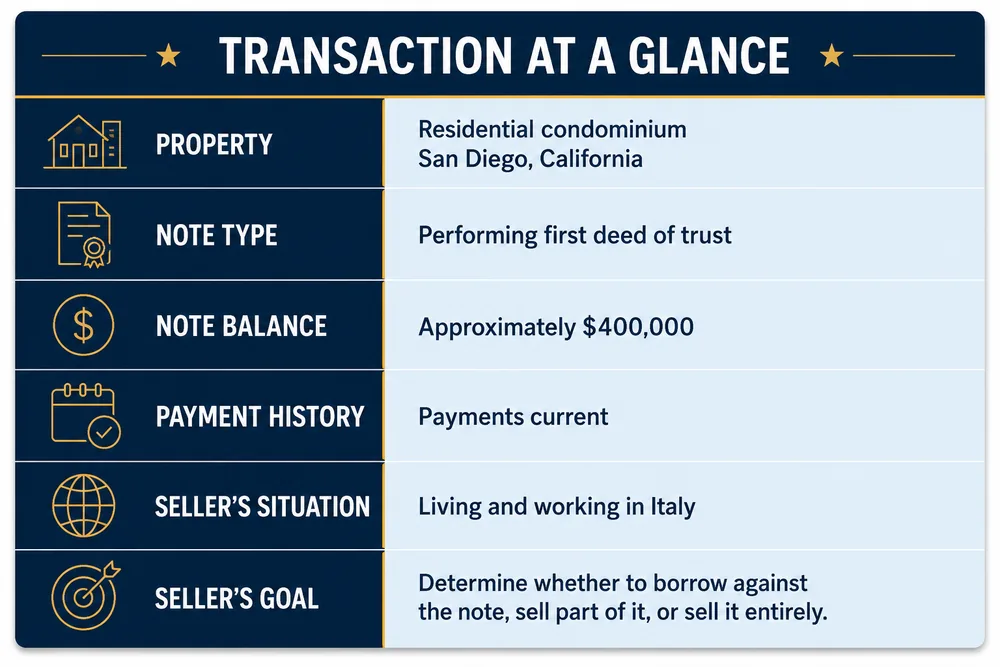
“David” was living and working in Italy when he contacted me about a mortgage note secured by a residential condominium in San Diego.
The note was performing. The borrowers were making their payments. David wasn’t dealing with a default or a problem property.
He simply wanted to turn some or all of the note into cash.
At first, he wasn’t sure how much.
He was considering a home equity line of credit. He was also looking at selling part of the note or selling the entire note.
And he wanted to understand the numbers before deciding.
By the time we were finished, David described the experience in his five-star Google review this way:
“Fast, reliable, and honest.”
Getting there took a little more work than those three words might suggest.
Meet David

About a year earlier, David had sold a residential condominium in San Diego.
The buyers had lived in the property as tenants for several years before purchasing it. David financed most of the purchase price and took back a first deed of trust.
The original note was approximately $400,000, carried a 5% interest rate and provided David with monthly payments of a little over $2,000.
The borrowers had been paying as agreed.
When David first contacted me, he was working from Italy.
That created an obvious complication.
There was a six-hour time difference between Italy and Florida (our main office) so telephone conversations weren’t always convenient. We used a combination of calls, emails and texts.
But distance wasn’t David’s biggest question.
He was trying to decide what made the most sense financially.
He was considering borrowing money through a HELOC.
He was also considering selling his mortgage note.
And if he sold the note, he didn’t yet know whether he wanted to sell all of it.
So we started there.
Not Sure Whether to Borrow or Sell Your Note?
You don’t need to decide before contacting us. We can compare keeping the note, selling part of it, or selling the entire note so you can see which alternative best fits what you’re trying to accomplish.
Actual Transaction
This story is based on an actual mortgage note transaction completed by American Funding Group.
The note holder’s and borrowers’ names and certain identifying details have been changed or omitted to protect their privacy. Some figures have been rounded, and conversations have been reconstructed from contemporaneous notes, emails and correspondence. The transaction and events described are real.
David’s note appeared to have several things working in its favor.
The borrowers had a good payment history.
They had lived in the condominium before buying it and had subsequently made improvements to the property.
There was equity behind the note.
And David held a first deed of trust.
Initially, I developed several alternatives for him.
One involved selling the entire note.
Others involved selling portions of the future payments and retaining some of the value for himself. Learn more about how a partial mortgage note sale works.
I sent David the alternatives and asked the same question I ask many note holders:
“Which offer comes closest to meeting your needs?”
At the same time, David was pursuing the HELOC.
For a while, both possibilities remained open.
Then he emailed me.
He was becoming frustrated with the HELOC process and wanted updated numbers on his note-sale alternatives.
He was leaning toward selling all or part of the note.
That was fine.
There wasn’t any reason for me to decide for him.
My job was to give him enough information to compare the choices.
Behind the Scenes
As David sent me the actual loan documents, we got a clearer picture of exactly what he owned.
One detail mattered more than it might seem.
The balloon date was sooner than we had initially understood. That meant there were fewer monthly payments remaining before the balloon, which affected the value and structure of the partial-sale alternatives.
I explained what we had found and recalculated the options using the actual terms of the note.
Then I emailed David:
“Tomorrow please tell me how much money you’d like to raise and let’s see what we can put together.”
That was really the question.
Not how much of the note could be sold.
How much money did David actually want?
At one point, we discussed a figure of approximately $100,000. That made a partial sale worth considering.
But David was still weighing his choices. He was looking at the HELOC, the partial-sale alternatives and what he could receive for selling the entire note.
There was no reason to rush that decision.
He needed to see the choices clearly enough to decide what worked best for him.
Eventually, he did.
His email was simple:
“Let’s get the best deal to just sell the note and we would like to move quickly.”
Now I knew exactly what David wanted.
Developing the Best Fit
Once David decided on a complete sale, my job changed.
We were no longer comparing a HELOC with different ways of selling the note. David wanted to sell the entire note, and he wanted me to get him the best deal I could.
At that point, I had made a good & fair offer.
But I wasn’t finished.
I had been talking with more than one investor, and another investor was showing interest in the note. I went back to one of our investors and told them where the pricing needed to be more competitive.
I was able to increase the offer to purchase the entire note.
The final purchase price was substantially better than where our full-sale discussions had started.
Once David was comfortable with the offer, I sent him the Mortgage Purchase Agreement and explained what would happen next.
We would begin due diligence at our expense, verifying the note, payment history, property, title and the other documentation necessary to complete the purchase.
David wanted to move quickly.
I told him we’d expedite it as best we could.
Closing a California Mortgage Note From Italy
A conventional closing would have been difficult.
The note was secured by California real estate.
The seller was in Italy.
And the original promissory note was physically in Italy with him.
We arranged to use a Remote Online Notary, or RON, so David could sign the closing documents electronically from overseas.

In theory, that solved the problem.
In practice, there were a few bumps.
Closing documents had to be updated.
Electronic invitations were sent and then replaced.
At one point, David received another notice saying the documents were being revised.
We stayed in constant communication because David shouldn’t have had to figure out what was happening between the title company, online notary and investor.
When a signing had to be rescheduled, we worked through it.
When David wanted to know when the money would be wired after signing, I got the answer.
When the completed RON package came back without a copy of his identification, I dealt with that too.
The original note still had to get from Italy to the United States, so we provided a prepaid shipping label and told David exactly what needed to be sent.
None of these issues changed the transaction.
They were simply things that had to be handled.
Eventually, the remote closing was completed.
Selling a Mortgage Note From Somewhere Else?
You don’t need to live near the property to complete a note sale. We can coordinate the due diligence, closing documents, remote signing, and delivery of the original note while keeping you informed throughout the process.
Achieving the Objective
David had started the process without knowing exactly what he wanted to do.
A HELOC was a possibility.
A partial sale was a possibility.
A complete sale was a possibility.
We worked through all three.
He ultimately decided that he wanted to sell the entire note, get the best price we could obtain and move quickly.

That’s what we worked toward.
The note passed underwriting.
The title and property work were completed.
David signed remotely from Italy.
The original promissory note was shipped back to the United States.
And the transaction funded.
What I find interesting is how David described the experience afterward.
There had been moving parts behind the scenes.
There had even been a few problems with the remote closing.
Yet that wasn’t what David remembered.
This was:
Google Review
★★★★★
Highly Recommend – Fast, Reliable, and Honest
“Working with Kevin Clancy at American Funding Group was a seamless experience from start to finish. As a mortgage note buying expert, Kevin delivered exactly what was promised—quick turnaround, transparent communication, and zero surprises. The entire process was efficient, and I felt confident every step of the way.
If you’re looking to sell a note, this is the team to trust. Fast, reliable, and truly professional.”
About the Author
Kevin Clancy is President of American Funding Group and has been purchasing private mortgage notes since 1989. Over more than three decades, he has helped note holders nationwide evaluate and sell performing, non-performing, inherited, divorce-related, and other real estate notes, including full and partial note purchases.
Kevin’s Take
There’s a difference between a transaction having no problems and a note seller feeling that the process was seamless.
This transaction had problems.
Nothing catastrophic.
But things came up.
We discovered that the balloon date was different from what we initially understood.
That changed the numbers.
David was trying to decide between borrowing money, selling part of his note and selling the entire note.
That took some working through.
He was living in Italy.
The original note was in Italy.
The remote closing process had some glitches.
Documents had to be changed, a signing had to be rescheduled, and an identification issue had to be corrected after the closing package came back.
Yet David’s review said:
“Zero surprises.”
I don’t think he meant that nothing unexpected happened.
I think he meant that he was never left alone with it.
When something changed, I told him.
When I needed information, I asked him.
When he had a question, I answered it or found the answer.
And when something wasn’t working properly behind the scenes, I worked on it.
David also said:
“I felt confident every step of the way.”
That’s probably the part of his review that means the most to me.
A note holder doesn’t need every transaction to be perfect.
He needs to know what’s happening.
He needs someone to tell him when something changes.
And he needs to know that the person he’s dealing with is still there when a problem comes up.
David was in Italy.
His property was in California.
His investor was somewhere else.
The closing people were somewhere else.
None of that really mattered.
We just needed to get the transaction done.
And we did.
Could Selling Your Mortgage Note Be Right for You?
You may not be sitting in Italy with the original promissory note in your hands.
But you may be facing the same basic decision David faced.
Do I borrow the money I need?
Do I sell only part of my mortgage note?
Do I sell the entire note?
How much would each alternative give me?
And what happens if I decide to move forward?
Those questions don’t have one answer that works for everyone.
Sometimes a partial sale makes the most sense.
Sometimes keeping the note makes more sense.
And sometimes, after looking at everything, selling the entire note is the better fit.
The first step is figuring out what you’re trying to accomplish.
Then we can look at your note and explain what may be possible.
If you own a mortgage note and would like to talk through your options, call me at (772) 232-2383 or request a confidential note evaluation.
You don’t have to know which option you want before you call.
That’s what the conversation is for.
📞 Call (772) 232-2383 or Get My Note Quote Now
Related Stories
More Real-Life Stories are being developed. Check out the real-life stories:
>Selling a Texas Mortgage Note… partial note purchase
>Selling a Florida Mortgage Note… full note purcahse
>Selling a North Carolina Mortgage Note… note purchase on inherited property