Selling a North Carolina Mortgage Note
How One Couple Turned an Inherited Property Into Owner Financing — and Eventually Cash
When Sally first contacted me about selling her North Carolina mortgage note, the note itself was doing what it was supposed to do.
The buyers were making their payments.
There was substantial equity in the property.
And Sally and her husband weren’t under pressure to sell.
They simply wanted to understand what their note might be worth and whether selling it made sense.
What looked fairly straightforward at the beginning eventually involved an inherited property, a manufactured home, missing documentation, questions about the home’s title, a third-party servicing company and, finally, an understandable concern just before closing.
There were quite a few things to work through.
Sally and her husband didn’t have to work through them alone.
Meet Sally
Sally and her husband, Mark, hadn’t planned on becoming mortgage note holders.
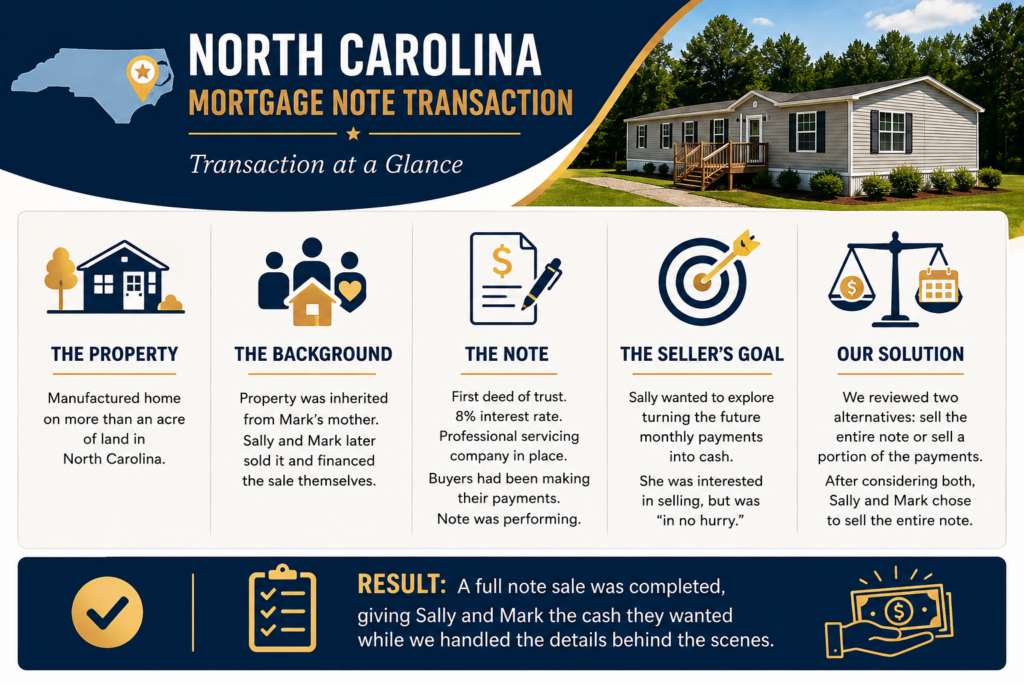
Years earlier, Mark’s mother had purchased a manufactured home on more than an acre of land in North Carolina. When she died unexpectedly, the property remained with the family.

A few years later, Sally and Mark decided to sell it.
The buyers made a meaningful down payment, and Sally and Mark financed the balance with a first deed of trust.
The note carried an 8% interest rate, and the buyers had been making their payments. A professional loan servicing company collected the payments and handled the escrow account.
Several years into the note, Sally began thinking about turning those future monthly payments into cash.
That’s when she found American Funding Group through our North Carolina Note Buyers page and contacted me.
On the initial form, she made two things clear.
She was interested in selling.
But she was “in no hurry.”
And the payments were current.
That gave us a good place to start.
Not in a Hurry—but Want to Know Your Options?
You don’t need an urgent reason to evaluate your mortgage note. We can review what you own and compare a full sale, a partial sale, or keeping the note—without pressure to move forward.
Actual Transaction
Instead of requiring the buyers to obtain conventional financing, they agreed to finance the sale themselves.
This story is based on an actual North Carolina mortgage note transaction completed by American Funding Group.
The names of the note holders and borrowers have been changed, and certain identifying details have been omitted to protect their privacy. Some financial figures have been rounded or described generally. Conversations have been reconstructed from contemporaneous notes, emails and correspondence.
The transaction and events described are real.
Selling Everything Wasn’t the Only Choice
One of the first things I try to determine is what a note seller actually wants to accomplish.
Sometimes selling the entire note makes sense.
Sometimes it doesn’t.
After reviewing Sally’s note, I was able to show her two different possibilities.
The first was selling the entire remaining note for a lump sum.
The second was a partial sale.
Under that alternative, Sally and Mark could sell several years of payments, receive a substantial amount of cash now and retain the remaining portion of their note.
When the purchased payments ended, the remaining payments would come back to them.
That gave them something important to think about.
They weren’t simply deciding whether to sell or not sell.
They were deciding how much of the note, if any, made sense to sell.
I called Sally to talk through the advantages and disadvantages of each alternative. My job wasn’t to decide for them.
It was to make sure they understood their choices.
After considering both, Sally and Mark decided that selling the entire note better fit what they wanted to accomplish.
We discussed the economics of the transaction, I did some additional work on the purchase, and ultimately we arrived at a full-sale proposal they were comfortable accepting.
They were ready to move forward.
Now we had to get it closed.
The Question We Couldn’t Ignore
Because the collateral included a manufactured home, there was an important question we needed to answer during due diligence:
What had happened to the manufactured-home title?
Sally wasn’t sure she and Mark had the documentation we needed. Some of the original records were difficult to locate because Mark’s mother had died unexpectedly years earlier.
That didn’t mean we couldn’t buy the note.
It meant we had some work to do.
Missing Documents or an Unusual Property?
An inherited property, manufactured home, missing records, or servicing issue does not automatically prevent a note sale. We’ll review what you have, identify what is missing, and determine whether the transaction can be completed.
Behind the Scenes
Sally and Mark searched through their records. They went back through old closing documents and contacted the attorney who had handled the property.

We reviewed the deed of trust and insurance information. Behind the scenes, I continued working to determine exactly what documentation would be required.
At one point, some of the information we had seemed contradictory.
So we kept looking.
Eventually, an inquiry with the North Carolina Department of Motor Vehicles gave us the answer we needed.
I emailed Sally: “I have really good news.”
The DMV information indicated that the manufactured-home title had been retired.
One of the biggest questions surrounding the transaction had been resolved.
But we still weren’t finished.
Developing the Best Fit
There were still a few pieces we needed before the note could make it through underwriting.
One was verified payment history.
Another involved the third-party servicing arrangement and determining exactly how the servicing expenses were being handled.
Those may sound like minor administrative details.
When you’re purchasing a mortgage note, they’re not.
We had been trying to obtain some of the information directly from the servicing company, but getting everything we needed was taking longer than expected.
So we kept at it.
Sally and Mark helped obtain the missing payment records. We also determined that they were paying the monthly servicing expenses themselves.
That meant the existing servicing arrangement would need to be addressed as part of the purchase.
This is the kind of work a note seller usually never thinks about when first asking, “What is my mortgage note worth?”
There is the value of the note.
And then there is everything that has to happen to turn that value into an actual completed transaction.
We continued working with Sally, the servicing company and the investor’s underwriting team until the remaining questions were answered.
Finally, we had what we needed.
The file went through underwriting.
The note purchase was approved.
We were headed to closing.
Closing a North Carolina Mortgage Note
Just before closing, Mark had one more concern.
He wasn’t comfortable signing documents transferring the note until he understood exactly how the purchase funds were being handled.
I understood.
If you’ve never sold a mortgage note before, think about what you’re being asked to do.
You’re signing documents transferring an asset you’ve owned for years.
It’s perfectly reasonable to want to know:
Where’s my money?
The purchase funds were being held in escrow by the title company, but they couldn’t be released until the required closing documents had been signed.
I could have simply told Mark, “That’s how note closings work.”
I didn’t think that would make him feel any more comfortable.
Coincidentally, we had completed another mortgage note purchase the previous day. In that transaction, the seller had asked his attorney to review essentially the same closing documents.
The attorney had approved them.
So I sent Sally the closing package Mark would be signing, along with the attorney’s approval of the substantially similar documents from the other transaction.
And I told her that she and Mark were welcome to have their own attorney review their closing package as well.
Sally responded, “Thank you, I appreciate it.”
That helped resolve Mark’s concern.
He signed the documents.
The transaction closed.
Achieving the Objective
A couple of days after closing, Sally received an unexpected notice from the former servicing company.
She didn’t know what it meant, so she contacted me.
Frankly, I didn’t know what it meant either.
And I told her that.
Then I went back to the people handling the transaction to find out.
The existing servicing arrangement had been terminated as planned, but there were still some administrative loose ends being generated by the former servicer.
We worked through those, too.
I think that small episode says something important about this transaction.
Closing doesn’t mean I suddenly stop answering the phone.
If something comes up afterward that’s connected to the transaction, I want the seller to know what’s happening.
When Sally first contacted me, she owned a performing North Carolina mortgage note and wanted to explore turning those future payments into cash.
Along the way, there was considerably more work involved than any of us could have anticipated at the beginning.
There was an inherited property.
There was a manufactured-home title to research.
There were old documents to locate.
There was payment history that took time to obtain.
There were servicing questions.
And there was an understandable concern immediately before closing.
But Sally and Mark accomplished what they had set out to do.
They sold their note and received their cash.
And they didn’t have to become the project managers of everything happening behind the scenes.
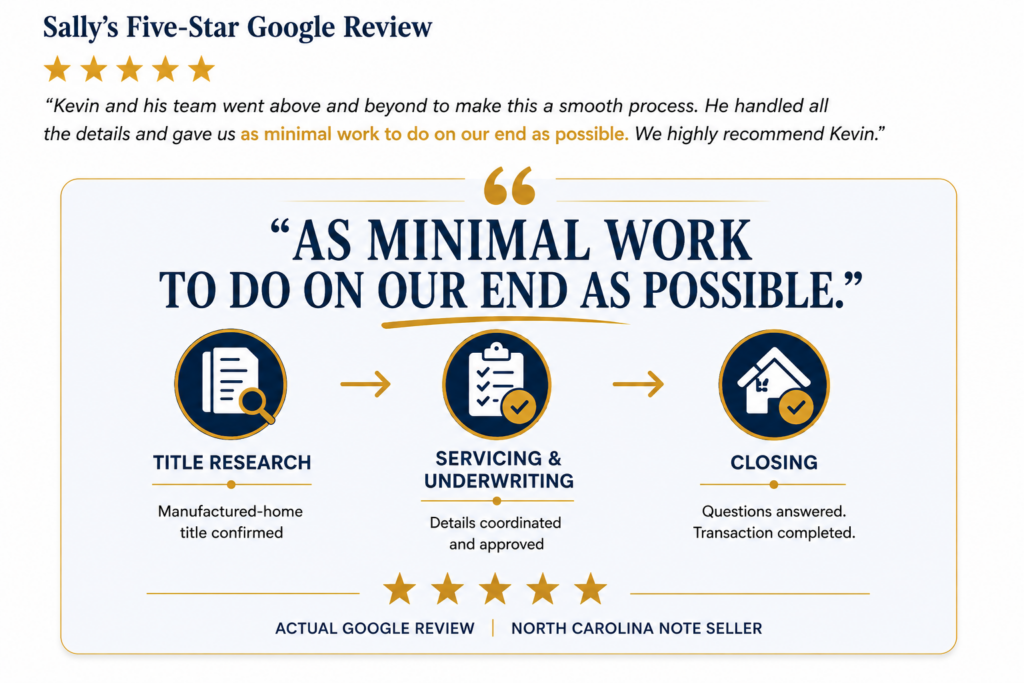
After closing, Sally left a five-star Google review, which meant a lot to me and my team.
Quite a bit happened behind the scenes.
Yet when Sally described the experience afterward, what she remembered was that we went above and beyond and gave them as minimal work to do on their end as possible.
That may be the best description of what I try to accomplish.
The note seller shouldn’t have to carry everything that goes on behind the scenes.
About the Author
Kevin Clancy is President of American Funding Group and has been purchasing private mortgage notes since 1989.
Over the years, he has worked with note holders across the country, purchasing seller-financed mortgages, deeds of trust, land contracts and other privately held real estate notes.
His approach is simple: understand what the note seller is trying to accomplish, explain the available alternatives and help work through the details required to get the transaction completed.
Kevin’s Take
There’s a tendency to think that a “good” mortgage note transaction is one where nothing goes wrong.
After doing this for more than three decades, I don’t look at it that way.
Things come up.
Documents are missing.
Records don’t always tell the whole story.
A servicing company may take longer than expected to respond.
Someone may have a perfectly reasonable concern before signing.
That’s real life.
What matters is what happens next.
In Sally and Mark’s case, the borrowers were making their payments and there was substantial equity protecting the note.
The challenge wasn’t necessarily the note.
The challenge was getting all the pieces together so the transaction could be completed.
We did.
Sally didn’t need to know about every email, phone call or conversation happening behind the scenes.
That was my job.
Could Selling Your North Carolina Mortgage Note Be Right for You?
If you own a seller-financed mortgage or deed of trust in North Carolina, you don’t necessarily have to sell all of it.
You may be able to sell the entire note for a lump sum.
Or you may be able to sell only a portion of the payments and keep the rest.
And if there’s something unusual about your situation—an inherited property, a manufactured home, missing documents or another complication—that doesn’t automatically mean your note can’t be sold.
Start by telling me what you have and what you’re trying to accomplish.
We’ll look at the note, talk through the alternatives and see what makes sense.
Sometimes the best solution isn’t obvious when we start.
That’s okay. That’s what the process is for.
📞 Call (772) 232-2383 or Get My Note Quote Now
Related Stories
More Real-Life Stories are being developed. Check out these real-life stories:
> Selling a Texas Mortgage Note… partial note purchase
> Selling a Florida Mortgage Note… full mortgage note purchase
>Selling a California Mortgage Note… sale from overseas